Mainline output impedance questions

phatfish

Member
Have a few questions about the impedance modes on the mainline and will add some full context below:

1. Is the low/high output impedance 32/64 ohms?
2. Is there any practical way to lower the output impedance of the low mode?


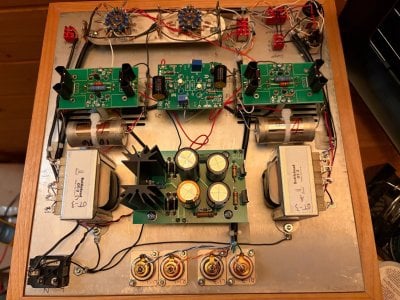
I'm using a Denon ah-d9200 (105dB 24-ohm dynamic driver) and I'm happy with the sound, but the impedance is rather low for a dynamic headphone. I'm currently building a Crackatwoa that I'll be using with my high impedance cans. Hoping that there is a way to simply move around some of the transformer connections similar to the power amps to reduce the output impedance on one/both modes of the mainline. The mainline will be fairly dedicated to the Denon cans so I'm ok with optimizing for them at the expense of some flexibility.
 
The stock wiring delivers maximum power at 32 or 64 ohms, the actual output source impedance is about 1/3 of the load - around 10 or 20 ohms.

Yes, the transformer can be re-wired for 8/16 ohm loads. The switching will need to be changed, too.
 
Thanks PJ! I'm currently chewing on if this is worthwhile or advisable to change for my setup... I had assumed the actual output impedance was higher. I have plenty of volume with this headphone's sensitivity, so I'm not worried about making less power. It appears that my headphone has a surprisingly flat impedance curve for a dynamic driver so this change would likely only add some dampening (and perhaps not much).

Could you walk me through what needs to change for 8/16-ohm loads? If it's pretty modest, I'll play around with it.
 
Could you walk me through what needs to change for 8/16-ohm loads? If it's pretty modest, I'll play around with it.
It's not modest. You will lose the High/Low impedance switch on the top plate, and you'll end up needing a bunch of switches and some extra resistors inside the chassis.
 
Gotcha. I was hoping it would be similar to how you can rewire the transformers on the power amp (Which admittedly I haven't done, but it sounded straightforward). Thx.
 
One more question on this. I was planning on updating the output caps on the mainline with some v-cap ODAMs with all the glowing reviews/comments. Short of it is looking for advice on going with 10uf vs 18uf caps given my flat 24Ohm headphone load.

Cap values seem to be a lot of "it depends" can of worms but given the largely flat impedance curve of my preferred headphones, I figure this should be more answerable. Any idea how I could calculate or estimate curves like what's here:

These caps ain't cheap, so I'd like to do my experimentation "on paper".

Thx again!
 
That link is still the "state of the art" as far as I know. My original study of the effects was done long ago (Win95?) and was simplified to assume the output transformer impedance was a pure resistance at the relevant frequencies and the iron had no resistive or hysteresis losses.

I can't access Pspice any more, but I do think there's more to the story than has been documented. There are some much better magnetic models being used these days.

With a flat 24-ohm resistive load, I think that 16uF would be a good guess. You might want to try getting a couple of cheap polypropylene 5.6uF caps (Solen? Dayton?) and paralleling the stock 10uF to see if there's an audible difference before springing for the fancy ones. Listen for distortion as well as frequency response - headphones eliminate room resonances, which makes them better than speakers for this task.
 
Thanks PJ, that's a good idea to simply mess around with some smaller cheap caps in parallel. Looks like the ODAMs come in 15uf or 18uf (also 12uf and 22uf further from your guess). Going to see if I can set up some real-world listening tests with these values.
 
Alright, went a bit overboard here but got sets of Dayton Audio Polypropylene Capacitors from parts express (seems to be same type as stock) that will allow me to test out the exact 12, 15, 18, 22 values available from v-cap. :cool:

Will report back with impressions.
 
Well, this was either an interesting or boring experiment given the conclusion. I get why those questions about some way to hot swap caps comes up from time to time. The differences are extremely subtle to my admittedly not great ears and it's really hard to have many takeaways.

Short of it is that I'm planning to stick with 10uf.

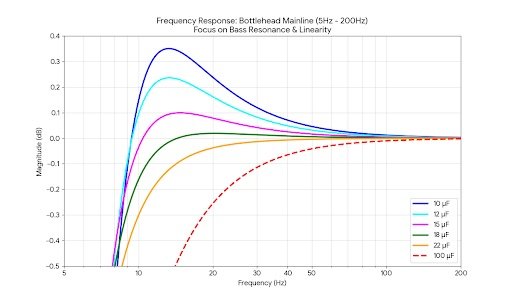
Trying 22uf I seemed to notice a touch less bass. I did reach for the volume which I'd like to think is an objective thing I did to compensate and prove this...but it could simply be that I was trying to listen extra hard to the bass. I do remember the move down to 18uf seemed to improve things in the bass department, so I kept walking down the values but not really clear on changes after that tbh.

About mid way through I did try asking AI for help. Gemini 3 pro did a convincing job of graphing things out…and seemed to gel with my impressions of 22 being ever so slightly worse in the base department but generally things being very close with no real wins on extension. Take this graph and my impressions with a massive grain of salt.
 

Attachments

  • IMG_0193.jpeg
    IMG_0193.jpeg
    35.3 KB · Views: 13
Back
Top