Capacitor Valve Reading method

gary

New member
I am helping out a friend with his C2a.

Question #1
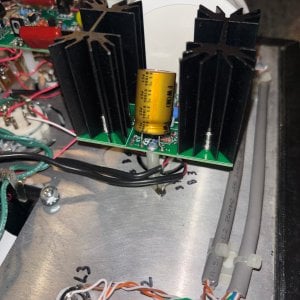
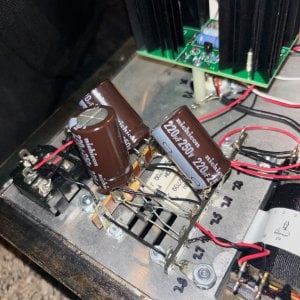
See the attached photos please
Can the shown capacitors be tester in place ?

Question #2
If there was a direct short in the bottom side of left side 7 pin voltage regulator between pin 5 and 4 , could that cause failure of 9 pin 12au7 tube heater within the tube itself. Eg, burner up the heater element. New 12au7 tube is a good result.

Question #3
What is the gauge and type of wire used on c4s board connections. What is a proper substitute or replacement?
 

Attachments

  • IMG_7084.jpeg
    IMG_7084.jpeg
    2.3 MB · Views: 13
  • IMG_7083.jpeg
    IMG_7083.jpeg
    2.1 MB · Views: 11
What kind of test are you wanting to do on the capacitors? Why do you think they need to be tested?

Pin 5 of the regulator is the plate, pin 4 is part of the heater. That will ground out the output of the A side C4S feeding that tube. There isn't enough current available under this fault to damage the heater of a 12AU7.

The wire provided with the kit is 22 AWG solid core wire with a teflon jacket. You can use wire with a plastic jacket, but be sure not to use stranded wire, and it's a good idea to buy wire that's tinned as well (not just bare copper under a jacket).
 
  • Like
Reactions: wkw
If you end up needing replacement parts anyway (or even if you don't, I guess) we could sell you some additional wire so you're not buying more than you need.
 
  • Like
Reactions: wkw
What kind of test are you wanting to do on the capacitors? Why do you think they need to be tested?

Pin 5 of the regulator is the plate, pin 4 is part of the heater. That will ground out the output of the A side C4S feeding that tube. There isn't enough current available under this fault to damage the heater of a 12AU7.

The wire provided with the kit is 22 AWG solid core wire with a teflon jacket. You can use wire with a plastic jacket, but be sure not to use stranded wire, and it's a good idea to buy wire that's tinned as well (not just bare copper under a jacket).
I don’t have a troubleshooting reason to check the capacitance of the capacitors. Because they are accessible and I have no history of who built this. That seemed reason enough. General I find testing capacitors in circuit a reliable method, unless perhaps they are tied to a resistor or something. I don’t have super skills for circuits, maybe barely any. lol. They tested in circuit not as the spec they are labled. That got me curious. Perhaps if they are out of spec that would reflect in the circuit testing at the end of the C2a manuel.
I generally trust 100% testing the capacitance of a capacitors out of circuit.

Thanks for the explanation of the 4/5 pin scenario. The owner user was experiencing a drop out in the left channel and moved the volt reg tube ( wiggled ). Mostly a left / right move as I understand. This was while the amp was running. He shut off, turned back on with different volt reg tubes. This is when he discovered the 12au7 was not functioning. I tested the 12au7 and I shows no shorts. But it is also dead. In the tube tester the tube actually warms ever so slightly, not noticeable filament glow. So that tube has passed away, new tube functions.

When I examined the bottom/ underside of the tube socket where the wires are soldered there was a small wick of solder at pin 5 in the direction of pin 4. This closed that open space between pins to a minimum distance and it is likely given the physical movement when pushing the tube around this created a short there, Its a theory only and a question moreso which prompted my earlier question regarding the possibility of shorting the 12au7

I appreciate your earlier reply and would like further feedback if you’re willing.

Thanks again
 
  • Like
Reactions: wkw
Short of seeing bulging on the top of one of those capacitors from it being installed backwards, there isn't going to be much of a reason to check those. That particular cap is 12,000 hour rated at 105C and a high ripple current, so I would estimate the lifetime to be at least 800,000 hours just based on the operating temperature of a Crack-a-two-a, and likely a fair bit more because we aren't pushing the ripple current all that hard, so maybe round it out at 1,000,000 hours. The Crack-a-two-a has existed for about 90,000 hours, so there's plenty of life left in those parts.

For uncertainty in a C2A, you'll want to look at the OA voltage on each of the high current C4S boards, and it should be very close to 150V, and the OA/OB on the smaller C4S board should be right around 70V. Deviations from these voltages are definitely worth investigating, and you'll probably find that the dead 12AU7 leaves the OA/OB voltages on that center C4S board up way higher than they should be.
 
  • Like
Reactions: wkw
Back
Top